
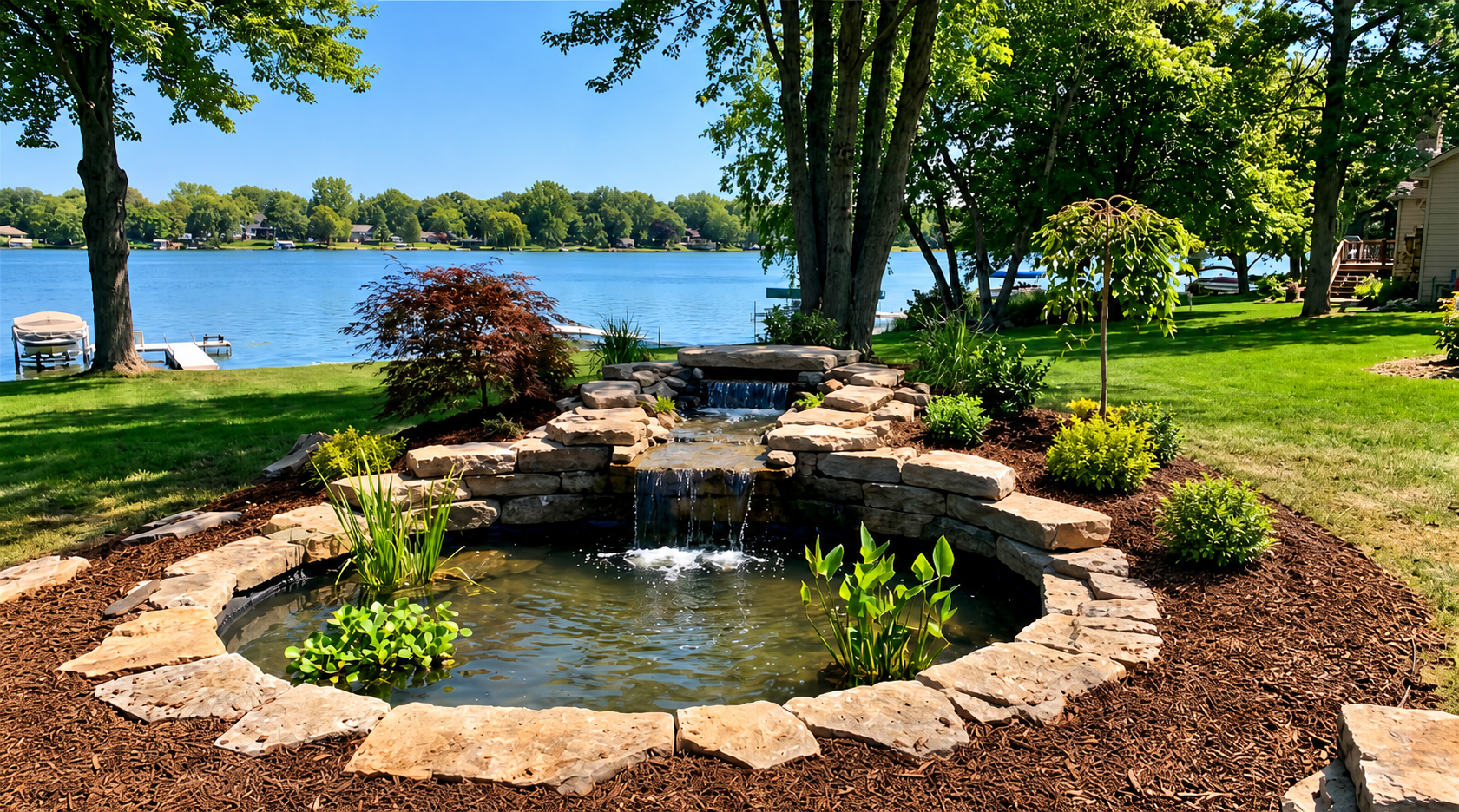
Water Feature Installation in Walled Lake, MI: How Soil and Drainage Shape the Build
Properties in Walled Lake, MI and Farmington Hills face different versions of the same challenge, and the gap between them is bigger than most homeowners expect. Walled Lake sits at the edge of an actual glacial lake, with lots that often slope toward the water, shallow seasonal water tables, and heavy clay soil that holds moisture long after a rainstorm clears. Farmington Hills, a few miles south, tends to have larger parcels, more varied topography, and soil profiles that shift block by block depending on how the land was graded during development. What works for water feature installation in Walled Lake, where a pond liner may sit just feet above a perched water table, is not the same approach that makes sense on a well-drained Farmington Hills hillside. Understanding those differences is the starting point for any water feature that actually performs the way it should.
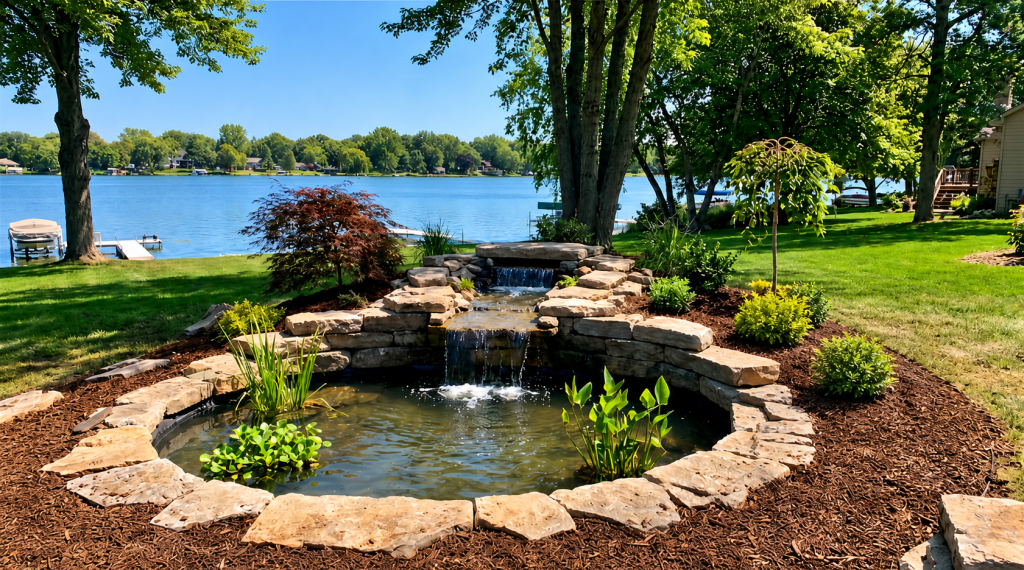
We often pair construction planning with resources from Michigan State University Extension on native plants and the Oakland County Water Resources Commissioner so drainage, planting, and long-term maintenance all work together.
What Glacial History Left Behind in Oakland County
The landscape around Walled Lake is the direct result of glacial retreat that ended roughly 10,000 years ago. The lake itself is a kettle lake, formed when a buried block of glacial ice melted and left a depression in the outwash plain. That origin story matters because it explains the soil layering homeowners deal with today. Much of the area around the lake sits on glacial till, a dense, poorly sorted mix of clay, silt, sand, and gravel deposited without any particular order. This material compacts easily and drains slowly. In yards that sit close to the lake or in low-lying pockets near Decker Road and the surrounding residential streets, groundwater can be surprisingly close to the surface, especially in April when snowmelt and spring rain arrive at the same time.
Farmington Hills developed on slightly different geology. The terrain there reflects more varied glacial landforms, including moraines and outwash deposits that produce better-draining sandy loam in some areas and equally stubborn clay in others. The point is that neither area has uniform soil, and any serious landscape project needs to account for what is actually in the ground, not what a general regional soil map suggests.
Why Water Feature Installation Walled Lake Requires a Site-Specific Drainage Plan
The proximity to Walled Lake creates a condition that surprises a lot of homeowners: the water table in spring can be high enough that a pond excavation fills with groundwater before the liner ever goes in. That is not a disaster, but it does change the construction sequence and the design choices. A pond that is fighting groundwater pressure from below needs a different liner approach and, in some cases, a perimeter drainage solution to keep hydrostatic pressure from lifting the liner over time.
Clay soil compounds this. Clay does not drain, it holds. A decorative fountain or waterfall that sits in a bowl of clay-heavy soil will often develop a soggy perimeter that never fully dries out between rain events. That standing moisture can heave pavers, erode planting beds, and create the kind of persistent wet zone that mosquitoes favor. Proper water feature installation in Walled Lake typically involves grading the surrounding area to direct overflow away from the feature, installing a gravel drainage envelope around the pond basin, and sometimes tying into a French drain system that carries excess water to a more appropriate outlet. We have written more about how clay soil affects drainage decisions in Oakland County in our article on French drains in Walled Lake, MI, which covers the same soil conditions from a different angle.
Native Plants and the Ecology Around Water Features in Southeast Michigan
One of the more rewarding aspects of designing water features in this part of Michigan is that the native plant palette is genuinely well-suited to pond and stream edges. Blue flag iris, native to Michigan’s wetland margins, thrives in the shallow margins of a backyard pond and provides early-season color in May and June. Swamp milkweed supports monarch populations and tolerates wet feet better than most perennials. Joe-pye weed, which can reach six feet in a moist spot, creates a naturalistic backdrop that makes a pond feel like it belongs in the landscape rather than sitting on top of it.
The USDA hardiness zone for Walled Lake is Zone 6a, with average annual minimum temperatures between negative 10 and negative 5 degrees Fahrenheit. That means pond equipment, including pumps, UV clarifiers, and any above-grade plumbing, needs to be either removed or properly winterized before the ground freezes. Aquatic plants in the pond itself need to be either hardy enough to overwinter in place or treated as annuals. Water hyacinth and water lettuce, popular for their ability to outcompete algae, will not survive a Michigan winter and need to be replaced each spring.
April Conditions and What They Tell You About Your Yard
April is actually one of the most useful months for reading a property’s drainage behavior. Right now, with snowmelt and spring rain working together, any low spot in your yard that stays wet for more than 48 hours after a rain event is telling you something important about what will happen around a water feature. A pond placed in that zone without proper drainage preparation will become a problem within a season or two.
We pay close attention to those wet zones during spring consultations, because they reveal drainage patterns that are invisible in July. If your yard has a spot that is still holding water a week after the last rain, that is worth addressing before any hardscape or water feature goes in, not after. Water feature installation in Walled Lake done in sequence, drainage first, then construction, consistently outperforms projects where drainage is treated as an afterthought.
If you are watching your yard drain this April and wondering what it means for a pond, waterfall, or fountain project, that observation is the right starting point. Reach out to our team at Outstanding Lawn and Landscape to talk through what the site conditions on your specific property actually require.
If your yard already has wet zones or drainage quirks, talk with Outstanding Lawn & Landscape before the build starts. We can assess the site, recommend the right prep work, and design a water feature that feels intentional instead of risky.