
Landscape Lighting in Walled Lake, MI: What a Well-Planned System Should Do
There is a particular kind of frustration that sets in around this time of year, when April evenings are still short on daylight and you are finally spending time outside again after a long Michigan winter. You have put real money into your landscaping, your beds look good, your paver patio is solid, but once the sun drops behind the tree line, the whole property disappears. That is the moment most homeowners around Walled Lake, MI start seriously thinking about landscape lighting. Walled Lake sits on the edge of an actual lake, and the waterfront terrain, mature tree canopies, and clay-heavy soils in this area create both unique opportunities and real installation considerations that generic systems simply do not account for. Not the solar stake lights from the hardware store, but a real, designed system that makes your property look intentional at night. If you have been searching for landscape lighting walled lake mi, you are probably past the stage of wondering whether it is worth it. You already know it is. The question is who does it right and what does a well-designed system actually involve in this area specifically.
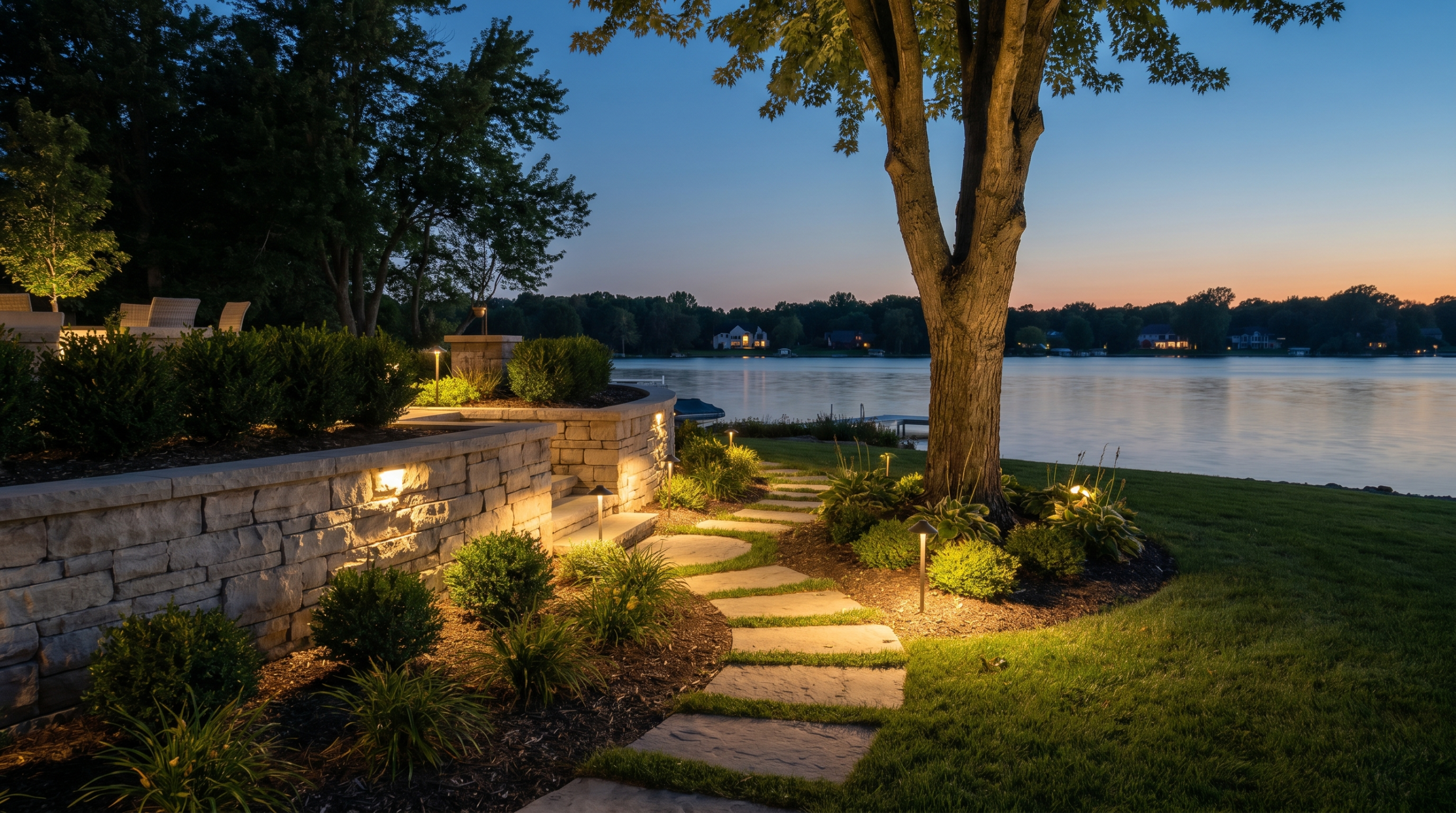
Our fixture layouts are shaped by Department of Energy guidance on outdoor lighting and DarkSky best practices for reducing glare, which helps us keep systems efficient, useful, and comfortable to live with year-round.
Why Walled Lake Properties Have Unique Lighting Opportunities
This is not a generic suburb. Walled Lake and the surrounding areas along Pontiac Trail, Lakeview Drive, and the neighborhoods closer to the lake itself have a lot of visual texture to work with. Properties near the water have something most Michigan homeowners do not: reflective surface at night. A well-placed uplighting fixture aimed at a mature oak or a weeping willow near the shoreline creates a doubled effect once it hits the water. We have installed systems on properties along the lake where the lighting design was built around that reflection intentionally, and the results are genuinely different from what you get inland.
Away from the water, the older neighborhoods around Walled Lake have mature tree canopies that most newer developments lack. That matters for landscape lighting because large trees give you structure to work with. Moonlighting, which is the technique of mounting fixtures high in a tree and angling them downward to mimic natural moonlight filtering through branches, works exceptionally well in areas with established hardwoods. If your property has 30-year-old oaks or maples, that canopy is an asset in your lighting design, not just your daytime curb appeal.
Landscape Lighting Walled Lake MI: What the Installation Process Looks Like
A lot of homeowners assume landscape lighting is straightforward, that you pick some fixtures, run some wire, and you are done. The reality is that a system designed to last, perform well through Oakland County winters, and actually look good requires a real plan. We start every project with a nighttime walkthrough of the property. You cannot design lighting in daylight. The way shadows fall, where the dark spots are, what draws the eye and what disappears, none of that is visible until the sun is down.
From there, we map out fixture placement, transformer sizing, and wire routing before anything goes in the ground. In Walled Lake specifically, we pay close attention to soil conditions and grade when routing low-voltage wire. This area has clay-heavy soil in many locations, which affects how we trench and how we protect conduit runs near areas with drainage movement. If your property has any grading concerns or low spots, reviewing our notes on French drains in Walled Lake, MI is a good starting point, because drainage and lighting often need to be coordinated on the same property to avoid future problems with buried wiring.
We use low-voltage LED systems almost exclusively at this point. The energy savings are significant over a season, the bulb life is far longer, and the color rendering has improved to the point where warm LED light is indistinguishable from what older halogen systems produced. For homeowners who want smart controls, we can integrate the system with timers, dusk-to-dawn sensors, or app-based controls that let you adjust zones, brightness, and scheduling without going outside.
Seasonal Considerations for Oakland County Lighting Systems
April is actually one of the better times to install landscape lighting walled lake mi homeowners can take advantage of. The ground is workable, the plant material is leafing out so you can see what the canopy will look like through the growing season, and you get the full benefit of the system through the long summer evenings before it gets dark late. Installing in fall or winter is possible, but spring installation gives you more time to evaluate the system while conditions are comfortable and make any adjustments before the leaves drop and the whole light dynamic changes.
Winter is also worth thinking about when you are choosing a system. Walled Lake gets real snow accumulation, and fixtures need to be rated for it. We spec fixtures that can handle freeze-thaw cycles without cracking lenses or corroding connections. Transformer placement matters too. A transformer mounted in a spot that gets buried under roof snow load or plow drift is going to cause problems. These are the kinds of details that separate a system installed by someone who works in Michigan from one installed by a company running the same template everywhere.
What a Finished System Actually Does for Your Property
Beyond the visual, a finished landscape lighting system does a few things that homeowners consistently tell us they did not fully anticipate. Security is one. A lit property is a less appealing target, and motion-integrated zones near entry points add a layer of awareness that passive lighting alone does not provide. Usability is another. Homeowners with lit patios and walkways use their outdoor spaces more, later into the evening and deeper into the shoulder seasons, which in Michigan means getting more value out of the landscaping investment you have already made.
Resale value tends to come up in these conversations too. In a market where buyers are comparing properties in Walled Lake and neighboring Commerce Township and Novi, a professionally installed lighting system photographs well and reads as a finished, maintained property.
If you are ready to talk through what landscape lighting walled lake mi looks like for your specific property, reach out to our team at Outstanding Lawn and Landscape. We have been working in this area long enough to know that the properties closest to the lake tend to underuse their best asset after dark. That is a problem worth solving.
Frequently Asked Questions
How long does a landscape lighting installation take in Walled Lake?
Most residential installations in Walled Lake take one to two days depending on the size of the property and the number of fixture zones. Larger properties with complex layouts or significant trenching may take longer.
Do landscape lighting systems hold up through Michigan winters?
Yes, provided the fixtures and transformer are properly rated and installed. We use commercial-grade fixtures designed for freeze-thaw conditions and position transformers to avoid snow accumulation issues common in Oakland County.
Can landscape lighting be added to an existing patio or landscaping?
Absolutely. Most of the systems we install are retrofits added to established landscapes. We route wiring to minimize disruption to existing beds, sod, and hardscaping.
What is the best time of year to install landscape lighting near Walled Lake?
Spring and early summer are ideal. The ground is workable, plant material is filling in, and you get the full benefit of the system through the warm months. That said, we install year-round when conditions allow.
If you want a lighting system that makes the property safer and more inviting after dark, schedule a consultation with Outstanding Lawn & Landscape. We can walk the site, identify the best fixture locations, and build a plan around how you use the space.